


Every Malaysian SME that sources from overseas or sells to international buyers faces the same reality: shipping import and export is rarely straightforward.
Between customs requirements, documentation, freight options, and compliance rules, a single misstep can delay shipments and tie up cash flow for weeks.
Solid Xpress forwarding agent in Port Klang handles end-to-end import and export operations, including paperwork and warehousing, so your business keeps moving.
This guide covers what Malaysian businesses need to know about sea freight, customs clearance, and documentation, and how we can take the complexity off your plate.
What Is Shipping Import and Export?

Shipping import and export is the process of moving goods in and out of Malaysia for international trade. It covers freight arrangements, shipping documents, customs requirements, and cargo delivery.
A reliable freight partner makes the process easier by coordinating the shipment, documentation, customs clearance, and final delivery with fewer delays.
The table below outlines how import and export operations differ at each stage:
| Stage | Import | Export |
|---|---|---|
| Documentation | Bill of lading, import permits, customs declaration | Commercial invoice, packing list, export declaration |
| Customs Clearance | Duties & taxes paid at port of entry | Export compliance check, licensing if restricted |
| Freight Mode | Sea (FCL/LCL), Air, Land | Sea (FCL/LCL), Air, Land |
| Typical Lead Time (Sea) | 10–30 days depending on origin | 5–25 days depending on destination |
| Solid Xpress Role | Full end-to-end import handling | Full end-to-end export handling |
Solid Xpress manages both sides of this equation, giving you a single point of contact regardless of whether goods are coming in or going out.
Speak with Solid Xpress for reliable import and export logistics support in Malaysia.
Why Sea Freight Remains the Backbone of Malaysian Trade

Malaysia’s major ports, including Port Klang and Penang Port, handle a large share of the country’s international trade volume.
Sea freight is often the most cost-effective option for large or heavy consignments, especially manufactured goods, raw materials, and consumer products.
There are two primary sea freight options to consider:
| Factor | FCL (Full Container Load) | LCL (Less Container Load) |
|---|---|---|
| Best for | Large, regular shipments | Small or infrequent cargo |
| Cost structure | Fixed per container | Charged per cubic metre / weight |
| Transit time | Faster, no consolidation wait | Slightly longer due to groupage |
| Risk of damage | Lower, no shared handling | Higher, cargo handled more |
| Solid Xpress can arrange | Yes | Yes |
As a general rule, FCL suits businesses with consistent, high-volume shipments, while LCL works well for SMEs testing new markets or managing irregular order cycles.
Solid Xpress advises on the best option based on your cargo profile and trade lanes.
Learn more about the difference between air freight vs sea freight and how the sea freight forwarding process works.
6 Key Documents for Shipping Import and Export

Malaysian importers and exporters need to prepare and verify the following shipping documents before cargo moves:
- Bill of Lading (B/L): The contract between shipper and carrier, and proof of ownership for the goods.
- Commercial Invoice: States the transaction value, used by customs to calculate duties and taxes.
- Packing List: Itemises the contents of each package, including weight and dimensions.
- Certificate of Origin: Confirms where goods were manufactured, affecting tariff rates under trade agreements like RCEP or ASEAN FTA.
- Import/Export Declaration (Customs Form K1/K2): Filed electronically via the RMCD (Royal Malaysian Customs Department) portal.
- Permits and Licences: Required for controlled goods such as food products, pharmaceuticals, chemicals, and certain electronics.
Solid Xpress prepares and manages all documentation on your behalf, reducing the risk of errors that lead to holds or penalties at the border.
Contact our team today to review your import or export requirements.
Customs Clearance in Malaysia: What Importers and Exporters Need to Know
Customs clearance is the process by which goods are legally authorised to enter or leave the country. In Malaysia, this is overseen by the Royal Malaysian Customs Department (RMCD) and handled through the uCustoms system.
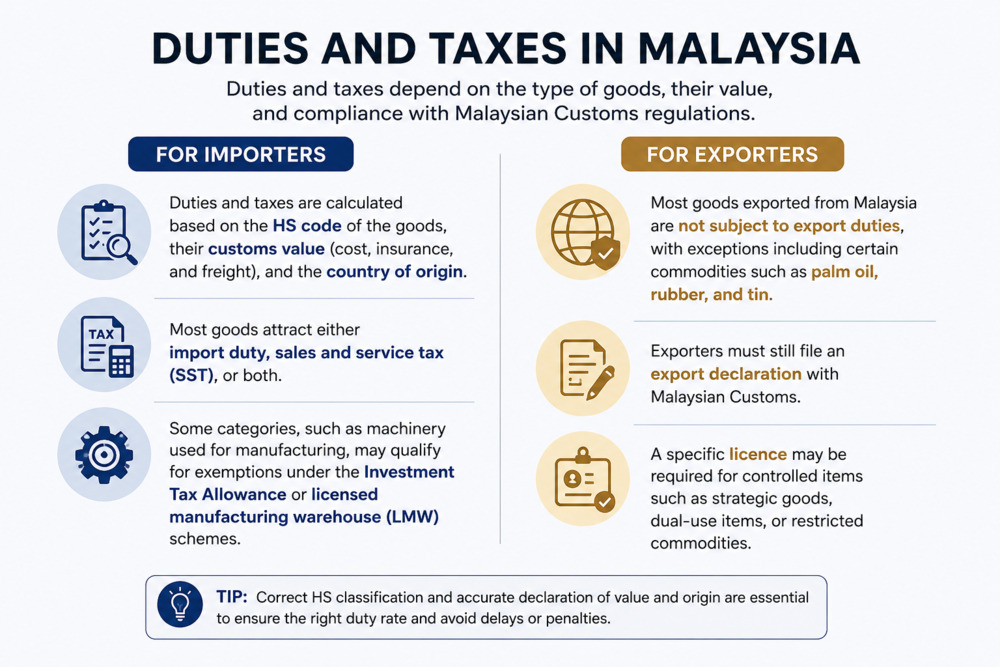
Solid Xpress;s licensed forwarding team ensures declarations are accurate, duties are correctly assessed, and clearance is obtained with minimal dwell time at the port or warehouse.
Find out more about how to get faster customs clearance through Solid Xpress custom clearance service.
Streamline Import and Export Shipments with Solid Xpress

Solid Xpress helps solve these challenges by acting as a single logistics partner for your business. You get one team to coordinate the full shipping process with better visibility and control.
- Freight booking and negotiation: Solid Xpress helps secure suitable freight options across FCL, LCL, sea freight shipping and air freight in Malaysia, and cross-border trucking freight with lorry transport in Malaysia based on your cargo needs and budget.
- Customs brokerage: Our licensed forwarding team manages declarations, permits, duty calculations, and customs clearance requirements to reduce clearance issues.
- Inland transportation: First-mile and last-mile delivery are arranged to keep cargo moving smoothly between origin, port, warehouse, and final destination.
- Warehousing support: Bonded and general warehousing solutions are available for cargo that needs storage, consolidation, or staging before distribution.
- Documentation management: Shipping documents are prepared, checked, and submitted accurately to minimise errors and avoid unnecessary delays.
SMEs can move goods more efficiently without building a full in-house logistics team.
4 Common Shipping Challenges Malaysian SMEs Face and How to Avoid Them

Understanding the pitfalls ahead of time saves money and avoids operational disruption. These are the issues Solid Xpress most frequently helps clients resolve:
1. Incorrect HS Code Classification
Using the wrong HS code results in either overpaying duties or triggering a customs audit. Solid Xpress verifies classifications before filing to ensure accuracy.
2. Insufficient Lead Time for Controlled Goods
Importing certain goods, such as food products, medical devices, and chemicals, requires permits from agencies like MAQIS, MOH, or DOE. These approvals take time. Planning logistics without accounting for permit lead times causes shipment holds.
3. Inadequate Cargo Insurance
Sea freight carries inherent risks, including damage and loss. Many SMEs underinsure or insure based on invoice value rather than replacement cost. Solid Xpress advises on appropriate cargo insurance coverage for each shipment.
4. Poor Visibility on Shipment Status
Without a logistics partner that provides real-time updates, businesses are left chasing shipping lines and agents for information. Solid Xpress provides proactive status updates at each stage of the shipment journey.
Reduce Shipping Delays with Solid Xpress by Your Side
Shipping import and export affects more than cargo movement. It impacts order fulfilment, operating costs, supplier timelines, and customer satisfaction.
When customs delays, documentation errors, or missed shipment windows happen, your business absorbs the cost.
Solid Xpress helps Malaysian businesses manage these risks with end-to-end freight support, licensed customs brokerage, warehousing, and inland transportation in one place.
Having us to coordinate the process ensures your shipments can move with better control, fewer delays, and clearer cost visibility.
Need support for your next import or export shipment? Contact Solid Xpress today to discuss your requirements and request a quote.
Frequently Asked Questions About Shipping Import and Export
1. What is the difference between FCL and LCL in sea freight?
FCL uses a full container for one shipment, while LCL shares container space with other cargo; Solid Xpress helps businesses choose the better option based on volume, cost, and delivery timeline.
2. What permits are needed to import goods into Malaysia?
Import permits depend on the product category, and Solid Xpress helps check whether your goods need approvals from relevant Malaysian authorities before shipment.
3. Does Solid Xpress handle customs clearance for imports and exports?
Yes, Solid Xpress handles import and export customs clearance in-house, including declarations, duty checks, and required documentation.
4. Can Solid Xpress arrange warehousing after goods arrive in Malaysia?
Yes, Solid Xpress provides bonded and general warehousing support for imported cargo that needs storage, inspection, consolidation, or distribution.